Permits and approvals
In short: A protection works notice is the Form 7 notice an owner must serve on the adjoining owner and the relevant building surveyor when the surveyor determines, on Form 6, that protection work is required (Building Regulations 2018, regulation 111). Part 7 of Victoria's Building Act 1993 then sets the process. The adjoining owner has 14 days to agree, disagree or ask for more information on Form 8.
Key takeaways
- The building surveyor decides whether protection work is required when deciding the building permit application, on Form 6, and gives a copy within 7 days.
- Form 7 must come with the surveyor's determination, 3 copies of Form 8, the approved statement, plans and specifications, and an allotment plan.
- The adjoining owner replies on Form 8 within 14 days. No reply means they are taken to have agreed.
- A disagreement goes to the building surveyor, whose Form 9 determination can be appealed to the Building Appeals Board within 14 days.
- Engineers' certificates, protection work plans and as-built plans of the finished protection work are all part of the process.
Served a protection works notice, or need to serve one? Get a quote or call 03 7048 4006, and send the building surveyor's determination, your plans and the notice.
This guide explains the process in the Building Act 1993 and the Building Regulations 2018. It is not legal advice.
What is a protection works notice?
A protection works notice is the notice an owner must serve on the adjoining owner and the relevant building surveyor before starting building work that needs protection work for the property next door (Building Act 1993, section 84). The Regulations call it a protection work notice, and it must be in the form of Form 7 (regulation 113).
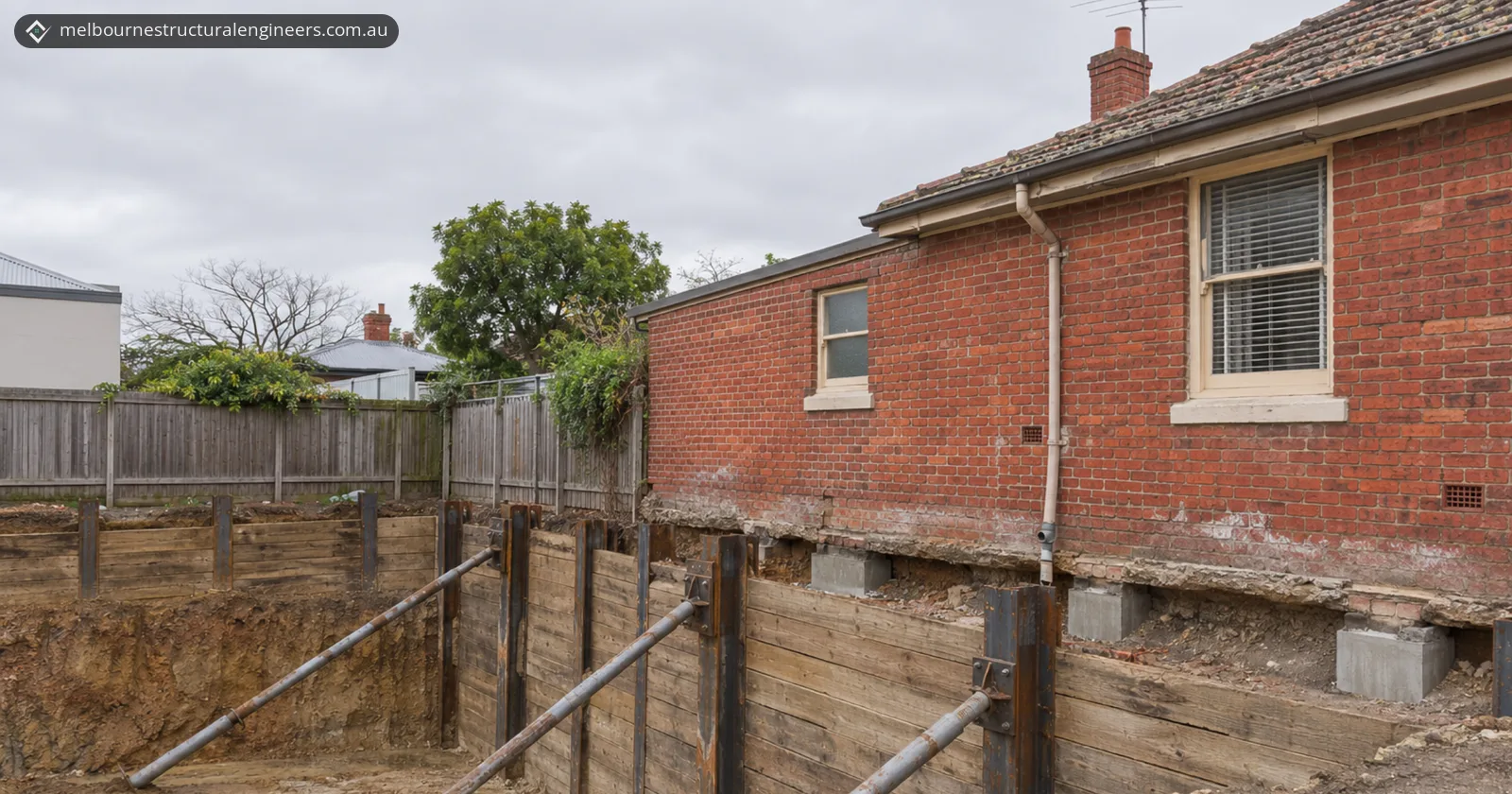
Under section 3 of the Act, protection work means permanent or temporary underpinning (including vertical and lateral support and ground anchors), shoring, overhead protection, or other work designed to keep the adjoining property stable or protect it from damage from the building work. An adjoining property is land at risk of significant damage from the building work, and it can include a street, lane, footway or right of way.
When does a building surveyor require protection work?
The relevant building surveyor must decide whether protection work is required when deciding the building permit application, and records that it is on Form 6, "Determination that protection work is required" (regulation 111). The relevant building surveyor is the municipal or private building surveyor handling the building permit (Building Act 1993, section 3). A copy of Form 6 goes to the permit applicant, and to the owner if they are not the applicant, within 7 days.
Under regulation 112, the surveyor must have regard to the allotment plan and specifications, any demolition or excavation, any work on party walls and retaining walls, and the likely damage to, or effect on the stability of, the adjoining property. They must also consider any section 238 certificate from the civil or structural engineer who designed the work, or from an independent civil or structural engineer.
Which forms are used in Victoria's protection work process?
Victoria's protection work process uses five forms from Schedule 4 of the Building Regulations 2018, plus a statement in a form approved by the Victorian Building Authority, which trades as the Building and Plumbing Commission (BPC).
| Form | What it is | Who gives it, and to whom |
|---|---|---|
| Form 6 | Determination that protection work is required | Relevant building surveyor, to the permit applicant and the owner (regulation 111) |
| Form 6A | Request to the council for the adjoining owner's contact details | Owner, to the council, if the owner can't find them after taking reasonable steps (regulation 113A) |
| Form 7 | Protection work notice | Owner, to the adjoining owner and the relevant building surveyor (regulation 113) |
| Form 8 | Protection work response notice: agree, disagree or request more information | Adjoining owner, to the owner, and also to the surveyor when disagreeing or asking for more information (regulation 114; section 85) |
| Form 9 | Notice of the surveyor's determination under section 87 | Relevant building surveyor, to the owner and the adjoining owner (regulation 115) |
What must a Form 7 protection work notice include?
A Form 7 notice must describe the proposed building work, including any damage it may cause next door, and the nature, location, time and duration of the protection work, including the access to the adjoining property it needs. Regulation 113 requires it to be served with:
- any Form 6 determination;
- 3 copies of the Form 8 response notice;
- the approved statement explaining the process and how disputes are resolved;
- plans and specifications showing how the building work will affect the adjoining property;
- plans and specifications showing how the protection work will protect it;
- one copy of an allotment plan complying with regulation 25(1)(d).
A structural engineer can prepare the plans and specifications in items 4 and 5.
What are the timeframes for a protection works notice?
The adjoining owner has 14 days after the protection works notice is served to respond, and an appeal against the surveyor's determination has a 14-day appeal period.
| Step | Timeframe | Rule |
|---|---|---|
| Surveyor gives a copy of the Form 6 determination | Within 7 days of making it | Regulation 111(5) |
| Adjoining owner responds on Form 8 | Within 14 days of service; no response means they are taken to have agreed | Section 85 |
| Appeal against the surveyor's section 87 determination | 14 days after the owner and adjoining owner are given notice of it | Section 141; regulation 271(1)(l) |
| Appeal against a request for more information | 14 days after the owner is asked for it | Regulation 271(1)(n) |
| As-built plans of the protection work | Within 2 months of finishing it; the surveyor sends a copy to the council within 7 days | Section 101 |
Under section 146, a determination that can be appealed doesn't take effect until the appeal period ends with no appeal, or the decision is affirmed on appeal.
How does the adjoining owner respond, and what happens next?
The adjoining owner responds on Form 8 by ticking agree, disagree, or request further information. If they agree, or don't reply within 14 days, the owner may carry out the protection work after getting any necessary permits or approvals (section 86).
If they disagree or ask for information, the relevant building surveyor must examine the proposal and decide whether it is appropriate (section 87). The surveyor may ask the owner for more information, and must then give the adjoining owner a copy. They may make any inquiries they think fit but don't have to hold a hearing. The decision is issued on Form 9, which states whether the proposal is appropriate or not appropriate and sets out the appeal rights.
Before protection work starts, the owner must also arrange insurance and a joint survey of the adjoining property. Our party walls guide covers those steps, costs and compensation.
How do appeals to the Building Appeals Board work?
The owner or the adjoining owner can appeal to the Building Appeals Board (BAB) against the surveyor's determination on whether the protection work is appropriate, a request for more information, or a failure or refusal to decide (Building Act 1993, section 141). The BAB has its own application form for protection work appeals.
- Deadline. The BAB says appeal periods are strict and, except in very limited circumstances, it has no power to extend them.
- What to lodge. The notice of appeal, a detailed written submission with the grounds and the outcome sought, and a payment details form. Copies of the notice and submission go to the other parties. Drawings, photographs, plans or expert reports can support it.
- Timing. The BAB aims to list completed appeals for hearing within four to eight weeks, and to decide within one to eight weeks after the hearing, depending on complexity and workload.
- Fast track. Under section 147, a party can ask the BAB to start dealing with the appeal within 2 business days. The BAB decides at its discretion, and says inconvenience alone won't normally justify it.
Disputes about the insurance, the survey, or the costs of assessing and supervising the work are dispute proceedings under sections 151 to 155, and an adjoining owner can apply for compensation under section 159.
Protection works in Melbourne and Victoria: the local rules
Protection works in Melbourne follow Part 7 of the Building Act 1993 and Part 7 of the Building Regulations 2018, the same as anywhere in Victoria. The BPC says you may be required to carry out protection work if your building work is close to or adjacent to adjoining property boundaries.
- Councils. If you can't find the adjoining owner after taking reasonable steps, you can ask the council for their name and address on Form 6A (section 84A).
- Emergencies. On an owner's or adjoining owner's application, the Victorian Building Authority may declare that emergency protection work is required, and the notice steps in sections 84 to 88 then don't apply (section 89).
- Penalties. Starting the building work that triggers protection work before agreement or a determination can attract up to 500 penalty units for a person, or 2,500 for a body corporate (section 88).
- Not a council permit. Protection works protect a neighbour's land. Council asset protection permits protect footpaths, kerbs and drains, and are a separate process.
What does a structural engineer do in the protection work process?
A structural engineer can design the protection work and document how the building work could affect the property next door. Under the Act and Regulations, engineering input can appear at several points:
- Before the determination: a section 238 certificate from the designing engineer or an independent engineer, which the surveyor must consider (regulation 112).
- With the notice: the plans and specifications for the building work and the protection work, such as underpinning, shoring or ground anchors (regulation 113).
- If the neighbour asks for more information: further detail the surveyor requests from the owner (section 87).
- After completion: plans, drawings and specifications of the protection work actually carried out (section 101).
When to call a structural engineer
Call a structural engineer as soon as your building surveyor flags protection work, or before you apply for the building permit if your plans include:
- excavation or a basement near a boundary;
- new footings, underpinning or demolition next to a neighbour's wall or footing;
- work on a party wall or a boundary retaining wall (see retaining wall design);
- an extension or new storey close to the boundary (see residential structural design).
If you're the adjoining owner, an engineer can check the protection work documents for you, and a dilapidation report records your home's condition before nearby work starts.
Frequently asked questions
Can the building permit be issued before protection work is agreed?
It may not be. According to the Building and Plumbing Commission, the permit can be held back until the building surveyor approves the completed protection work steps.
Can the adjoining owner see the full plans of the building work?
Yes. Once the notice is given, the relevant building surveyor must, on request, make the plans, drawings and specifications of the proposed building work that they hold available for the adjoining owner to inspect, free of charge (Building Act 1993, section 92).
Who pays for the adjoining owner's engineer?
The owner carrying out the building work. Under section 97 of the Building Act 1993, the neighbour's necessary costs of assessing the proposal and supervising the protection work are reimbursed by that owner, in an amount the two agree or the Building Appeals Board sets. The BPC says this covers fees for specialists who check the documentation.
Can protection work be required after the building permit is issued?
Yes. Regulation 111(3) of the Building Regulations 2018 says the relevant building surveyor may determine at any time that protection work is required in relation to building work, using the same Form 6.
Sources
- Building and Plumbing Commission (Victoria): Protecting adjoining properties
- Victorian Legislation: Building Act 1993, authorised version 153 (sections 3, 84 to 101, 141, 146, 147 and 159)
- Victorian Legislation: Building Regulations 2018, authorised version 032 (regulations 111 to 115, 271 and Schedule 4 Forms 6 to 9)
- Building Appeals Board: Appeal proceedings
- Building Appeals Board: Dispute and compensation proceedings